

Introduction: Why Patience Matters
in Learning
In today’s world, where every student is trying to get ahead of others, we have forgotten
about the importance of patience. Patience is an essential quality that enhances our ability
to learn new things and tackle complicated problems effectively.
Patience in learning helps students to stay motivated and enhances their ability to learn.
Instead of giving up quickly, patient learners continue to practice and improve their
skills. This mindset not only improves academic performance but also builds confidence and
resilience—which is why, in this blog, we will learn about the importance of patience for
students.
What is Patience in
Learning?
Patience in learning means staying calm, focused, and persistent while gaining knowledge or
learning a new subject. In short, it means understanding that learning takes time and that
mistakes and challenges are part of the journey.
Patience can be considered a skill that helps you stay in control of your emotions so that
you make better decisions in critical or challenging situations. This approach allows
students to develop stronger problem-solving skills and build a deeper connection with the
subject they are studying.
Why is Patience
Important for Students?
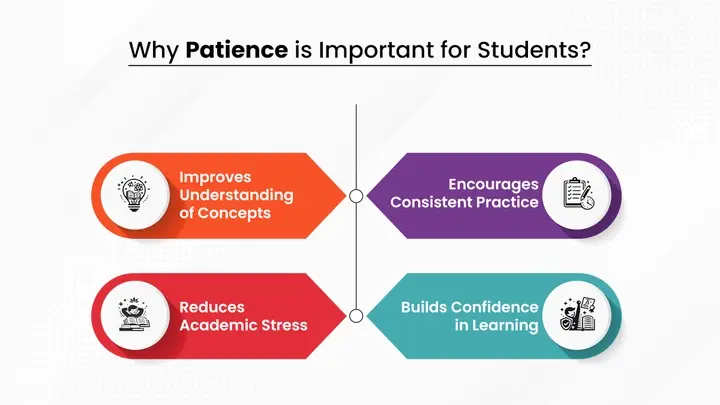
Patience helps students understand concepts, encourages consistent practice, reduces academic
stress, and builds confidence. Here is a brief explanation of its importance:
1. Improves Understanding of Concepts
When students take their time to learn a concept, they understand it more clearly instead of
simply memorizing information.
2. Encourages Consistent Practice
Patience helps students stay calm, which leads to persistence and regular practice. This is
essential for mastering new skills and subjects.
3. Reduces Academic Stress
Many students feel stressed because of exams and studies. In this situation, patience helps
them stay calm while knowing that learning takes time when facing difficult topics or
exams.
4. Builds Confidence in Learning
As students patiently work through challenges, they begin to trust their abilities and gain
confidence in their academic journey.
How Patience Helps
Students to Become Better Learners
Patience plays a major role in shaping effective learning habits. Students who practice
patience tend to focus better during lessons and remain calm while solving complex
problems. Instead of rushing to complete tasks, they take time to analyze information and
understand different perspectives.
Patient learners are also more willing to ask questions, review difficult topics, and keep
improving until they achieve clarity.
Role of Teachers in
Developing Patience in Students
Students see teachers as role models. They are an important part of their lives, helping them
to learn progressively and stay motivated. Teachers create a supportive and encouraging
classroom environment, helping students understand that learning takes time and efforts.
Teachers guide students step by step, provide constructive feedback, and encourage them to
keep trying even when they face difficulties. Through positive reinforcement and structured
learning activities, teachers help students stay motivated and develop a patient mindset
toward education.
How Schools Can
Encourage Patience in Learning
Schools can help students learn patience by adding activity-based learning, group
discussions, and project-based assignments, which allow students to explore topics at their
own pace.
Encouraging practice, reflection, and collaborative learning also helps students understand
that improvement comes with time and consistent effort. A positive school environment
helps students stay motivated and patient throughout their academic journey.
Patience in Learning
at Vivekanand Assandh School
At Vivekanand Assandh School, patience is considered an important part of the learning
process. Our school encourages students to learn the importance of patience. We encourage
students to learn with curiosity, dedication, and a willingness to improve step by step.
Teachers provide continuous guidance and create an environment where students feel
comfortable asking questions and learning from their mistakes. Through supportive teaching
methods and interactive learning experiences, the school helps students develop patience,
confidence, and strong academic skills.
Conclusion: The Importance of Patience
Patience is an essential quality that helps students grow academically and personally.
When students understand that learning is a gradual process, they become more focused,
confident, and willing to overcome challenges. Instead of rushing through lessons, patient
learners take the time to study and understand concepts clearly, leading to a stronger
understanding and better problem-solving skills.
Developing patience also prepares students for future success, as it builds resilience,
determination, and a positive mindset toward learning. At Vivekanand Assandh School, we
believe that every child learns at their own pace, and with the right guidance and support,
they can achieve their full potential. By nurturing patience, curiosity, and confidence, the
school helps students build strong foundations for lifelong learning and success.
FAQs: The Importance of Patience for
Students
1. What is the importance of patience in education?
Ans- Patience in education helps students stay calm, make better decisions, and learn
new things at their own pace.
2. Why is patience important for students?
Ans- Patience helps students understand concepts, encourages consistent practice,
reduces academic stress, and builds confidence.
3. Why is patience a good skill?
Ans- Patience can help you maintain the positive mindset you need for personal
improvement.