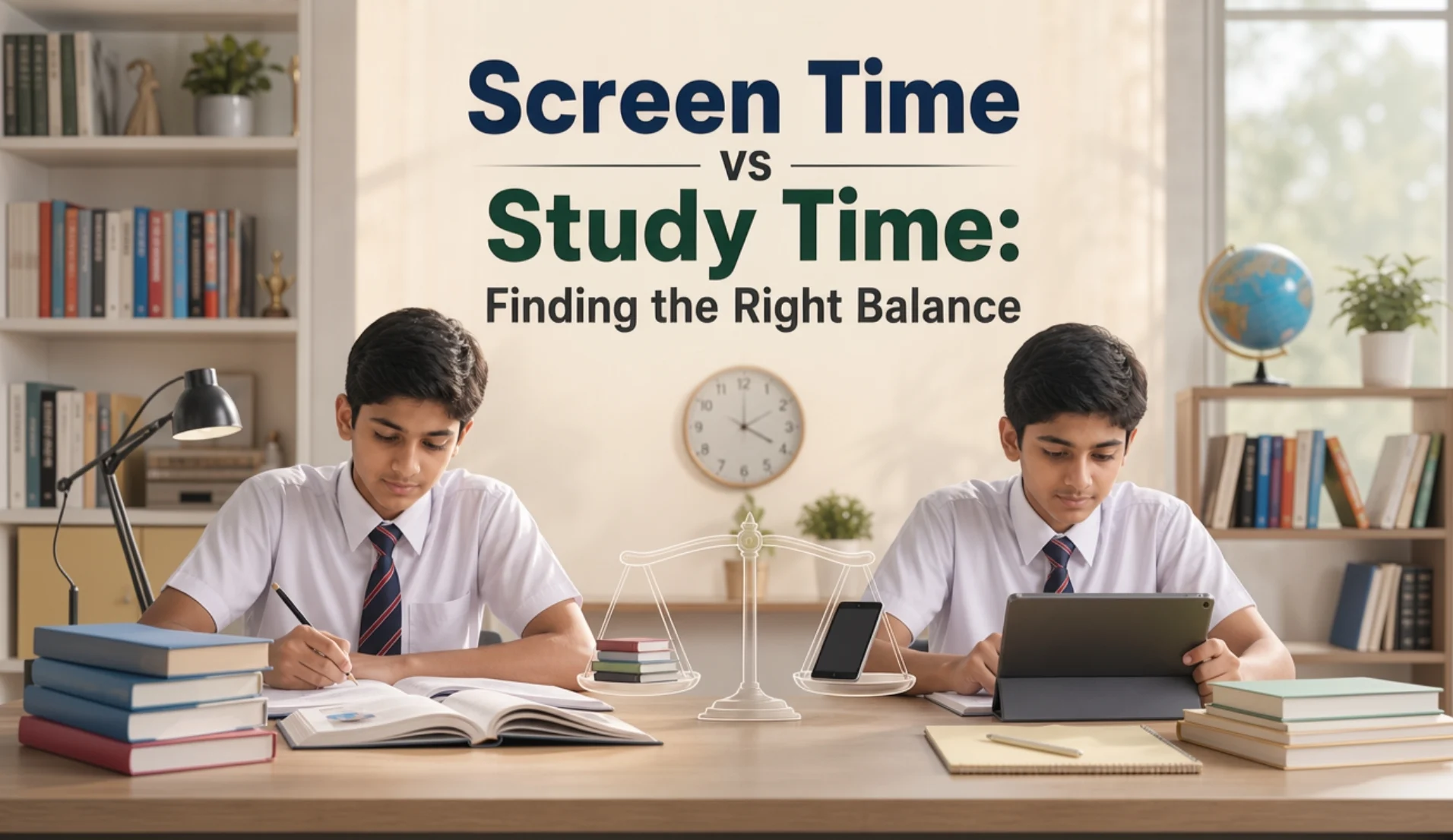
Screen Time vs Study Time: How to Balance Both?

screen time vs study time

Introduction: Finding Balance Between Screen and Studies

Modern times have made screens a major part of our lives. Studies show that teenagers in India have an average screen time of 4-6 hours. Higher screen time is creating many problems in a student’s life, and one of the biggest is a low retention rate.

Technology has taken over the minds of students, but it is not the real problem; it’s just a tool that, when used wisely, can actually help students with their studies rather than creating problems.

In this blog, we will explore how to create the perfect balance between screen time and study time, and reveal how to use technology to help students learn better and faster.

What Is the Right Amount of Screen Time for Students?

Studies suggest that students can use screens for entertainment for up to 2 hours per day. When students exceed that limit, the screen begins to have a significant impact on their brains.

But, as mentioned before, screen time is not the problem; the problem is what it is used for. Many schools have started using laptops and tablets instead of regular books. Educational screen time does not affect students negatively if used correctly and for a certain duration; instead, it helps make lessons more interesting.

How Can Screen Time Affect Students’ Studies?
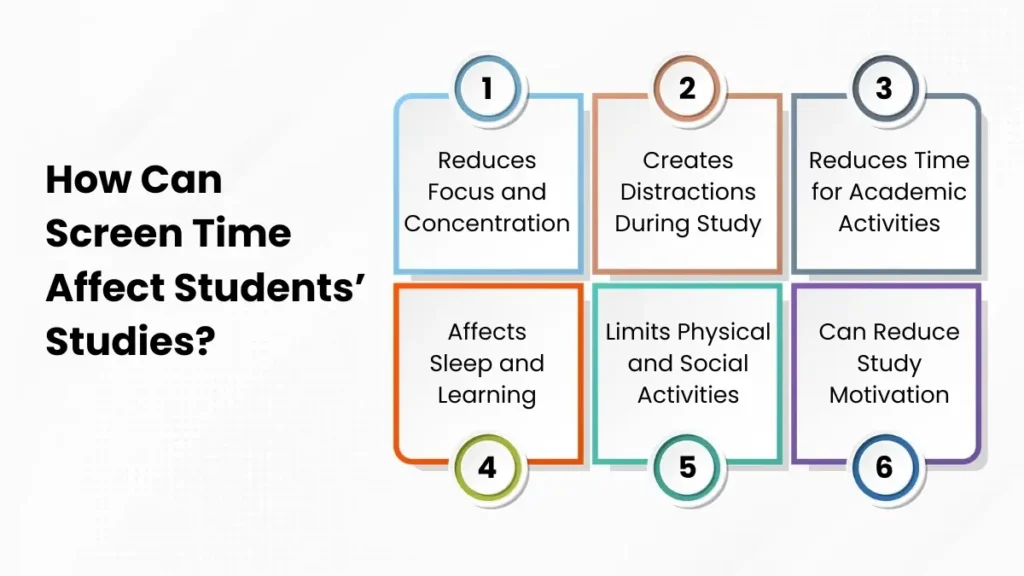
how can screen time affect student studies

Screen time is useful only when used for educational purposes, and that too for a certain duration. If we use screens for an excessive amount of time for entertainment, then it:

1. Reduces Focus and Concentration

Scrolling on social media affects your retention and concentration, making it harder for students to focus during study time.

2. Creates Distractions During Study

Using these devices excessively can get students addicted and distract them while studying. Even when studying, when they don’t require any kind of screen, their mind will automatically search for it to scroll through social media, play games, or binge-watch.

3. Reduces Time for Academic Activities

Using screens for multiple hours for entertainment purposes leaves them with little to no time to read, revise, or complete homework. The time that can be used to prepare for upcoming exams usually gets spent scrolling.

4. Affects Sleep and Learning

Using a phone just before going to sleep affects students’ sleep quality. Poor sleep makes students tired throughout the day, making it hard for them to focus on studies and related activities.

5. Limits Physical and Social Activities

With the high use of screens, students have stopped playing outdoor games, reducing their physical activity. Not going out or interacting with friends or new people can trigger social anxiety.

6. Can Reduce Study Motivation

Engaging daily with highly addictive screen entertainment may make students lose interest in studies. 

How Can Technology Support Student Learning?
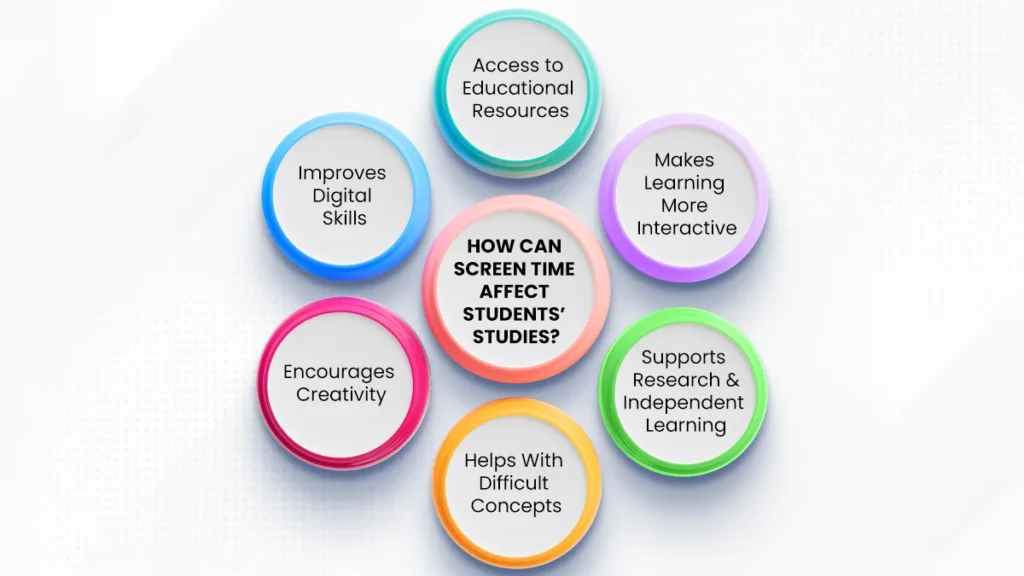
how can technology support student learning

Here are some ways technology actually helps students support their learning:

1. Access to Educational Resources

With the help of the internet, students can access the required resources wherever and whenever they want. They can access useful resources on their phones or laptops. 

2. Makes Learning More Interactive

When students have access to technology, they can learn from online learning platforms that provide engaging content. These online educational platforms are designed to spark curiosity and keep them engaged during the learning sessions.

3. Supports Research and Independent Learning

Technology allows students to research topics, find reliable information, and explore subjects they are curious about. This encourages independent learning and develops research skills.

4. Helps With Difficult Concepts

Every student has a different learning capacity; students with weak learning capacity can rewatch their lessons to understand the concept, while other students can revise or explore the advanced level of the concept.

5. Encourages Creativity

Digital tools like Google Slides, Microsoft Excel, and other similar worksheets can help students present their assignments in more creative ways, increasing their creative learning in the process.

6. Improves Digital Skills

The world is driven by technology, so using it daily helps students increase the digital efficiency that helps them in the future for various roles or projects. It cultivates a sense of responsibility in them.

Screen Time vs Study Time: How to Create a Healthy Balance

AreaWhat Students Should DoHow It Helps
Create a Daily Schedule Set dedicated time for studies, screen use, physical activities, hobbies, and rest.Helps students maintain a balanced routine.
Set Screen-Free Study HoursKeep phones and unnecessary devices away while studying.Reduces distractions and improves concentration.
Use Screens With a PurposePrioritize educational content over unnecessary scrolling and entertainment.Makes screen time more productive and meaningful.
Take Regular BreaksTake short breaks between study sessions instead of switching to prolonged screen use.Helps refresh the mind and maintain focus.
Avoid Screens Before BedtimeReduce unnecessary screen use before going to sleep.Supports a healthier sleep routine and better daytime focus. 
Make Time for Outdoor ActivitiesInclude sports, exercise, walking, or outdoor games in the daily routine.Supports physical health and provides a healthy break from screens.
Balance Online and Offline LearningCombine digital resources with books, writing, discussions, and practical activities.Develops well-rounded learning habits.
Review Screen Habits RegularlyCheck how much time is spent on learning versus entertainment.Helps students become more responsible about their technology use.

How Parents Can Help Students Manage Screen Time

Parents can help students create a proper schedule that will help them manage time efficiently and function throughout the day. Making dedicated time slots for studying, playing, screen use, hobbies, and family time helps children develop a balanced daily routine.

Parents should also tell their children to use technology productively instead of just for entertainment. Educational videos, learning apps, online research, and digital resources can make studying more interactive, while sports, reading, creative activities, and family time provide healthy alternatives to screen use.

Also, parents should be an example and lead their children by not using excessive screens for entertainment in front of them.

How Vivekanand Assandh Encourages a Balanced Approach

At Vivekanand Assandh, we believe technology should support learning rather than become a constant distraction. We encourage students to use digital tools meaningfully while maintaining a healthy balance between classroom learning, screen-based activities, reading, sports, co-curricular activities, and personal time.

Our teachers guide students towards responsible use of technology and help them develop important skills such as time management, self-discipline, and focused learning. By combining technology with practical activities, discussions, physical education, and creative experiences, students get opportunities to learn in different ways.

Conclusion: Screen Time vs Study Time

Today, technology is an important aspect of a student’s life and can provide them with knowledge and intelligence if used properly. When students use technology wisely, they gain benefits such as access to more educational resources, and learning becomes more interactive and interesting. It helps with research and independent learning, explains difficult concepts, encourages creativity, and improves their digital efficiency.

In this technology-driven journey, parents can also help their children by guiding them to make a proper timetable and inspiring them to use technology for educational purposes more than for entertainment. If you are looking for a school that helps students understand the importance of technology in studies and also helps parents guide their children, contact Vivekanand Assandh today!

FAQs: Screen Time vs Study Time

1. Is 7 hours of screen time unhealthy?

Ans: Yes, 7 hours of screen time is very unhealthy for your mind. Experts recommend using screens for up to 2 hours for entertainment.

2. Does screen time lower IQ?

Ans: Yes, excessive screen time for doom-scrolling or entertainment can lower your IQ.

3. What is Gen Z’s average screen time?

Ans: The average screen time of Gen Z is 4-6 hours per day.

4. What are 5 negative effects of screen time?

Ans: Here are 5 negative effects of screen time:

  • Reduces focus and concentration
  • Creates distractions during study
  • Reduces time for academic activities
  • Affects sleep and learning
  • Limits physical and social activities
Vivekanand Vidya Niketan, Assandh Editorial Team

Educational Insights & Student Development

Related Articles

IX – X
Analytical
Thinking
Practical
Learning
Leadership
Skills

Secondary School

The Senior Secondary programme prepares students for academic excellence, competitive success, and future careers. With experienced faculty, structured mentoring, career counselling, and personalised academic support, students develop the confidence and knowledge required to excel in board examinations, competitive entrance tests, and higher education while growing into responsible leaders.

Key Focus Areas

  • Board Examination Excellence
  • Career Guidance
  • Competitive Preparation
  • Research & Innovation
  • Leadership & Personality

Subjects Offered

  • English Language & Literature (184)
  • Hindi Course A (002)
  • Mathematics (041)
  • Science (086)
  • Social Science ( 087)
Experiential Learning
Global Awareness
Curiosity

Educational Excursions

Learning Beyond Classroom Walls
Educational visits provide practical exposure, broaden perspectives, and connect classroom concepts with real-world experiences through engaging field trips and explorations.

What Students Develop

  • Observation Skills
  • Practical Understanding
  • Curiosity
  • Collaboration
  • Cultural Awareness
  • Confidence

Activities Offered

  • Educational Tours
  • Heritage Visits
  • Museum Visits
  • Industrial Visits
  • Nature Camps
  • Science Centres
  • Agricultural Visits
  • Historical Excursions
Leadership
Responsibility
Community Service

Leadership Activities

Preparing Leaders for Tomorrow
Leadership opportunities help students become confident, responsible, and collaborative individuals who are ready to make meaningful contributions inside and outside the classroom.

What Students Develop

  • Leadership
  • Responsibility
  • Teamwork
  • Decision Making
  • Confidence
  • Discipline

Activities Offered

  • Student Council
  • House System
  • NCC
  • Assembly Leadership
  • Event Management
  • Community Service
  • Leadership Workshops
  • Team Projects
Scientific Inquiry
Innovation
Problem Solving

Science & Innovation

Curiosity That Creates Innovation
Hands-on experiments, STEM learning, robotics, and scientific exploration inspire students to think critically, solve problems, and innovate with confidence.

What Students Develop

  • Scientific Thinking
  • Problem Solving
  • Innovation
  • Research Skills
  • Creativity
  • Collaboration

Activities Offered

  • cience Laboratories
  • STEM Activities
  • Robotics
  • Science Exhibitions
  • Innovation Projects
  • Working Models
  • Coding Basics
  • Experiment-Based Learning
Creative Expression
Artistic Skills
Innovation

Art & Creativity

Where Creativity Comes Alive
Students explore imagination through art, music, dance, theatre, and creative activities that encourage self-expression, innovation, and confidence beyond academics.

What Students Develop

  • Creativity
  • Self Expression
  • Imagination
  • Confidence
  • Fine Motor Skills
  • Artistic Appreciation

Activities Offered

  • Drawing & Painting
  • Craft Activities
  • Music
  • Dance
  • Theatre
  • Poster Making
  • Rangoli
  • Cultural Performances
  • Art Exhibitions
Communication
Critical Thinking
Leadership

Debate & Public Speaking

Confident Voices That Inspire
At Vivekanand Vidya Niketan, Assandh, students build confidence through debates, speeches, declamations, and public speaking activities that strengthen communication, critical thinking, and leadership.

What Students Develop

  • Public Speaking
  • Communication Skills
  • Critical Thinking
  • Confidence
  • Leadership
  • Logical Reasoning

Activities Offered

  • Debate Competitions
  • Declamation
  • Extempore
  • Public Speaking
  • Anchoring
  • Presentations
  • Group Discussions
  • Elocution
Physical
Fitness
Teamwork
Leadership

Sports & Athletics

Building Strength Through Discipline and Teamwork
At Vivekanand Vidya Niketan, Assandh, sports inspire students to develop fitness, confidence, resilience, and leadership through regular training, competitive participation, and teamwork. Every game encourages discipline, determination, and a healthy sporting spirit.

What Students Develop

  • Physical Fitness
  • Discipline
  • Teamwork
  • Leadership
  • Confidence
  • Sportsmanship

Sports Offered

  • Football
  • Handball
  • Volleyball
  • Netball
  • Basketball
  • Athletics
  • Judo Karate
  • Boxing
  • Cricket
  • Wushu
  • Kabaddi
  • Kho Kho
  • Skating
  • Badminton
  • Chess
IX – XII
Expert
Mentorship
Performance
Analytics
Competitive
Success

Competitive Excellence Programme

The Competitive Excellence Programme at Vivekanand Vidya Niketan, Assandh is designed to help ambitious learners achieve their highest academic aspirations. With integrated classroom learning, expert mentorship, regular assessments, mock examinations, doubt-solving sessions, and personalised guidance, students receive structured preparation for IIT-JEE, NEET, Olympiads, Foundation courses, and other competitive examinations while maintaining excellence in school academics.

Key Focus Areas

  • IIT-JEE Preparation
  • NEET Preparation
  • Foundation Programme
  • Olympiad Training
  • Mock Tests & Assessments
  • Personalised Mentorship

Programme Includes

  • Integrated School + Competitive Curriculum
  • Expert Faculty
  • Regular Mock Tests
  • Doubt-Solving Sessions
  • Performance Tracking
  • Study Material
  • Career Guidance
IX – XII
Academic
Excellence
Career
Readiness
Future
Leaders

Senior Secondary

The Senior Secondary programme prepares students for academic excellence, competitive success, and future careers. With experienced faculty, structured mentoring, career counselling, and personalised academic support, students develop the confidence and knowledge required to excel in board examinations, competitive entrance tests, and higher education while growing into responsible leaders.

Key Focus Areas

  • Board Examination Excellence
  • Career Guidance
  • Competitive Preparation
  • Research & Innovation
  • Leadership & Personality

Subjects Offered

  • English Core(301)
  • Physics (042)
  • Chemistry (043)
  • Biology (044)
  • Physical Education(048)

Subjects Offered

  • English Core(301)
  • Physics (042)
  • Chemistry (043)
  • Mathematics (041)
  • Physical Education (048)

Subjects Offered

  • English Core(301)
  • Accountancy (055)
  • Business Studies (054)
  • Economics(030)
    (OR)
    Mathematics (041)
  • Physical Education (048)

Subjects Offered

  • English Core(301)
  • Hindi Core (302)
  • History (027)
  • Economics(030)/Political Science(028)
    (OR)
    Mathematics (041)
  • Physical Education (048)
VI – VIII
Analytical
Thinking
Practical
Learning
Leadership
Skills

Middle School

The Middle School years empower students to become confident learners, independent thinkers, and responsible individuals. Through concept-driven academics, practical applications, collaborative learning, and leadership opportunities, students strengthen analytical abilities while preparing for higher academic challenges. A balanced curriculum encourages curiosity, innovation, teamwork, and personal growth.

Key Focus Areas

  • Critical Thinking
  • Concept-Based Learning
  • Scientific Temper
  • Leadership Development
  • Collaboration & Teamwork
  • Skill-Based Learning
  • Digital Literacy

Subjects Offered

  • English
  • Mathematics
  • EVS / Science
  • Social Studies
  • Computer Science
  • Art & Craft
  • Physical Education
Nursery – II
Early Learning
Creative Play
Social Skills

Foundational Years

The Foundational Years at Vivekanand Vidya Niketan, Assandh create a joyful beginning to every child’s learning journey. Through play-based experiences, interactive classrooms, and nurturing guidance, children develop confidence, curiosity, communication skills, and strong early literacy and numeracy foundations. Every day is designed to inspire exploration, creativity, and a lifelong love for learning in a safe and caring environment.

Key Focus Areas

  • Early Literacy & Numeracy
  • Language Development
  • Social & Emotional Growth
  • Play-Based Learning
  • Creativity & Imagination
  • Motor Skill Development
  • Values & Good Habits

Subjects Offered

  • English
  • Hindi
  • Mathematics
  • Environmental Awareness
  • Art & Craft
  • Music & Dance
  • Physical Education
  • Storytelling & Communication
  • Activity-Based Learning
Classes I – V
Conceptual
Learning
Creativity
Life Skills

Primary Wing

The Primary Wing strengthens conceptual learning while encouraging creativity, communication and experiential learning. Students are guided through practical activities and collaborative experiences that build strong academic foundations.

Key Focus Areas

  • Conceptual Understanding
  • Communication Skills
  • Creativity & Innovation
  • Experiential Activities

  • Discipline & Responsibility
  • Collaboration & Teamwork

Subjects Offered

  • English
  • Mathematics
  • EVS / Science
  • Social Studies
  • Computer Science
  • Art & Craft
  • Physical Education