

Introduction: Why Time Management is
Crucial During Exams
Many students face pressure and stress during exams because they are required to complete
tasks within strict time limits. When time management and task scheduling are poor,
stress often turns into anxiety.
To avoid this pressure and anxiety, students must understand the importance of time
management for better performance during exams. In this blog, we will discuss some tips
that help students manage their time during exams.
What is Time
Management for Students?
Time management for students is the process of planning, prioritizing, and controlling
study hours to maximize academic performance, reduce stress, and balance extracurricular
activities.
Many students study 8 hours and score 70 marks out of 100, while some only study for 4
hours and get 90 marks. This is because students don’t need to focus on studying longer;
all they have to do is study effectively.
Busy studying is when students keep repeating the same chapters again and again
without understanding, which only causes confusion.
Productive studying is about understanding the meaning of the chapters and learning
them in your own simple way.
Productive studying helps in managing time, giving students time to stay stress-free and do
other important things which interest them.
Time Management
Tips for Students During Exams
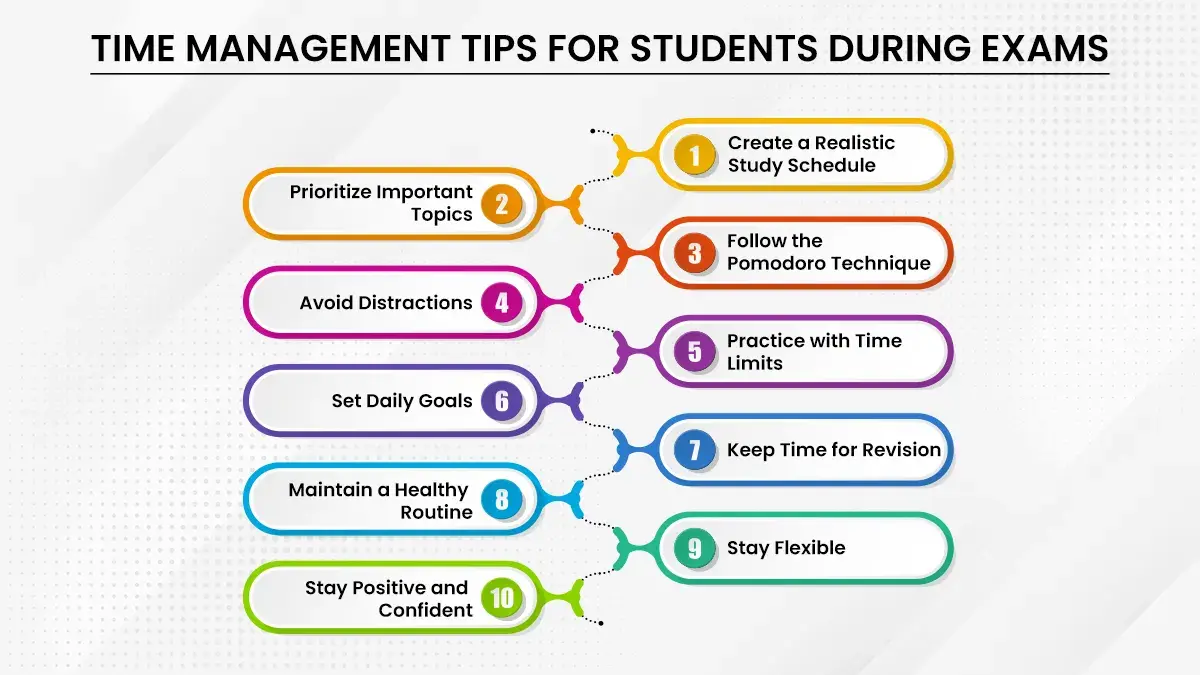
Here are some time management tips for students to use during exams:
1. Create a Realistic Study Schedule
Break your syllabus into smaller, manageable parts instead of trying to study everything at
once. Allocate time according to subject difficulty and exam dates. A clear study plan
reduces confusion and helps you stay consistent.
2. Prioritize Important Topics
Identify the chapters and topics that carry the most weight and require more practice. Start
your study session with these selected subjects when your mind is fresh, usually in the
morning or after a proper break.
3. Follow the Pomodoro Technique
The Pomodoro Technique, which means studying for 25–50 minutes, then taking a 5–10 minute
break, helps the mind stay fresh during study sessions.
4. Avoid Distractions
To avoid additional distractions, make sure the room is well-lit and silent. Avoid having
your phone in the same room or put it on silent, as it can cause distractions.
5. Practice with Time Limits
Solve previous years’ question papers or mock tests within a fixed time. This improves
speed, accuracy, and confidence during the actual exam.
6. Set Daily Goals
Instead of vague plans like “I will study Maths,” create a timetable that helps you to study
the particular chapter for that day, like “Complete Chapter 3 exercises and revise
formulas.”
7. Keep Time for Revision
Revision is just as important as learning new topics. Schedule short revision sessions every
day to strengthen memory retention.
8. Maintain a Healthy Routine
Get 7–8 hours of sleep, eat balanced meals, and include light physical activity. A healthy
body supports a focused and active mind.
9. Stay Flexible
If you miss a study session, don’t panic. Adjust your timetable instead of giving up.
Flexibility keeps you consistent without stress.
10. Stay Positive and Confident
Time management works best when combined with a calm mindset. Trust your preparation and
focus on progress rather than perfection.
People Also Read: The
Importance of Mindfulness from a Young Age
How Proper Schedule
Management Reduces Exam Stress
Instead of studying everything in one go, students can divide subjects into smaller
sections and revise them gradually. This balanced approach reduces mental fatigue and helps
the brain absorb information more effectively. When preparation is consistent, confidence
naturally increases, and stress levels decrease.
Moreover, schedule management ensures that students get enough rest, sleep, and short
breaks. Proper sleep and relaxation are essential for memory retention and focus. When
students follow a realistic and organized timetable, they feel more in control of their
preparation, leading to a calmer mindset and better performance during exams.
Conclusion: Time
Management Tips for Students
Time management is not about studying for long hours; it is about studying smartly and
consistently. When students learn to plan their schedule, prioritize key topics, and
balance study sessions with proper rest, exams become more manageable and less
stressful.
By shifting from busy studying to productive studying, students can achieve better results
without feeling overwhelmed. At Vivekanand Assandh, we guide students not only in academics
but also in developing effective time management and stress-free study habits. If you want
your child to learn smart study techniques in a supportive and disciplined environment,
contact Vivekanand Assandh today and help them prepare confidently for every exam and
beyond.
FAQs: Time Management Tips for
Students
1. What is the golden rule of time management?
Ans- Complete the difficult (important) tasks first; it is the golden rule of time
management.
2. How can students manage time?
Ans- Here are 10 tips for time management:
- Create a Realistic Study Schedule
- Prioritize Important Topics
- Follow the Pomodoro Technique
- Avoid Distractions
- Practice with Time Limits
- Set Daily Goals
- Keep Time for Revision
- Maintain a Healthy Routine
- Stay Flexible
- Stay Positive and Confident
3. How to be a top 1% student?
Ans- To be a top 1% student, you need a combination of active learning, consistent
discipline, strategic study habits, and a growth mindset.