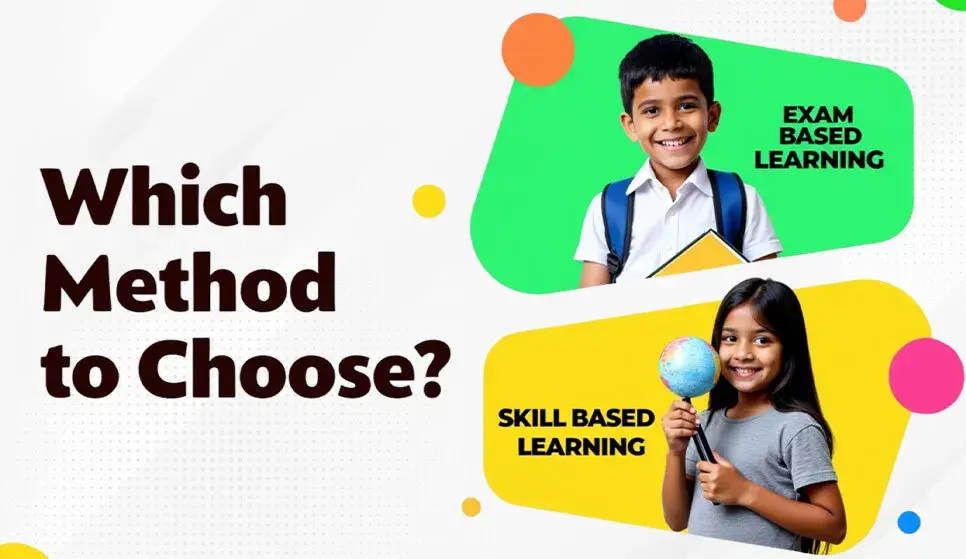
Which method to choose? Skill-Based vs Exam-Based Learning

Introduction:

In schools, the exam-based education system has been going on for the past 50 years. This system runs on the basis of a 10+2+3 structure.

The 10+2+3 system is a structure where students complete 10 years of schooling, followed by 2 years of high school, and then a 3-year undergraduate degree.

But over the past 10 years, the rise of skill-based systems started, which were based on learning skills and implementing them.

Then after many debates, the question arises, which one is better: Skill-Based or Exam-Based Learning.

In this blog, we will discover what Skill-Based and Exam-Based Learning are. The advantages and disadvantages, and which is best for your child.

Understanding Exam-Based Learning

Exam-based education is based on a structured learning of 15 years, where students complete 10 years of schooling, followed by 2 years of high school, and then a 3-year undergraduate degree.

It also includes graduation for another 2 years.

The East India Company introduced this education system to select suitable individuals for government positions within the colonial administration.

Understanding Skill-Based Learning

Skill-based education emphasises the ability to perform real-world tasks and adapt to different situations, often in the context of learning, training, and hiring.

This type of learning focuses on learning skills that can be immediately applied in a work setting or other real-world scenarios.

This education system was founded by John Dewey, which was then shaped by Paul Fitts, emphasising learning by doing, experiential learning, which are core tenets of skill-based learning.

The Historical Context of Exam-Oriented Education

This system started with informal oral assessments, which then evolved towards practical evaluation and written tests.

During colonial rule, education systems were often designed to produce clerks and administrators for the colonial bureaucracy. These systems emphasised rote memorisation, strict discipline, and standardised exams.

These evolved to select candidates for administrative roles, valuing test performance over practical ability.

Over time, many countries adopted this model for school and university admissions, reinforcing a system where passing exams became the central goal of education.

The Rise of Skill-Based Education in the Modern World

The rise of skill-based education is significantly influenced by the rapid evolution of technology and the shifting demands of the Indian job market.

As automation and artificial intelligence reshape industries, employers are increasingly valuing practical skills such as critical thinking, problem-solving, collaboration, and digital literacy.

Traditional rote learning and theoretical knowledge often fail to equip students with the adaptability required in such dynamic environments.

Consequently, educational instituitions are now restructuring educational systems to prioritise real-world skills that match current and future job market needs, ensuring students remain relevant and employable.

Skill-based and exam-based learning differ fundamentally in their focus and approach.

Comparing Core Focus: Knowledge Retention vs Practical Application

Skill-based learning:

It emphasises the development of life skills such as critical thinking, creativity, collaboration, and adaptability. It encourages hands-on projects, real-world problem-solving, and interdisciplinary understanding.

Exam-based learning:

It prioritises the retention of theoretical knowledge, structured curriculum completion, and performance in standardised assessments. While the former nurtures independent and experiential learning, the latter often fosters discipline, consistency, and academic rigour.

Cognitive Development and Learning Styles

Cognitive Development:

This is the growth of a child’s ability to think, reason, solve problems, and understand the world.

Skill-based learning often enhances cognitive flexibility, critical thinking, and creative reasoning. In contrast, exam-based learning may support memory development and structured thinking, but it can be limited in fostering deeper cognitive growth.

Learning Styles:

These are the different ways individuals absorb, process, and retain information, like visual, auditory, kinesthetic, or reading/writing preferences.

Skill-based learning accommodates a broader range of styles through interactive, hands-on projects and collaborative methods. In contrast, exam-based learning usually favours auditory and reading/writing styles due to its lecture and textbook-heavy structure.

Assessment Methods: Standardised Tests vs Performance-Based Evaluation

Standardised Tests:

Exam-based learning prioritises standardised tests by giving students exams at least three times a year to develop their learning abilities and grasp knowledge.

This puts a great emphasis on the student’s mind, making them sharper and increasing their learning power. But exam-based learning often limits development to what fits inside the pages of a textbook.

Performance-Based Evaluation:

Skill-based learning prioritises performance. It provides students with real-life problem-solving skills, which makes them ready to encounter problems technically and logically.

It uses critical thinking and creative hands-on projects to make them sharper and innovative in their ways. But performance-based learning limits the technical understanding.

Real-World Preparedness and Employability

Both educational systems can help students get jobs and have healthy lifestyles. But which is better when it comes to real-world Preparedness and Employability?

Skill-based learning is better when it comes to real-world preparedness, but the value of a degree is still there in many countries, which makes exam-based systems also a priority.

The best thing would be to collaborate on both the learnings, creating a massive impact on the student’s life. If the students get both skill-based and exam-based learning, they become ready for the real world while having great grasping power and excellent skills.

Hybrid Learning Models: The Best of Both Worlds?

It refers to educational models that combine elements of both skill-based learning and exam-based learning.

These approaches aim to merge the strengths of each system, offering the structure and academic rigour of exam-based formats alongside the flexibility, creativity, and real-world relevance of skill-based methods.

Blended models are increasingly being adopted in modern educational systems to meet diverse learner needs and better prepare students for both academic success and life beyond the classroom.

Which is Better for Your Child? Factors to Consider

While both systems have their advantages and disadvantages, which is well-suited for your child? These are some factors to consider while choosing:

Personality: Creative and mindful students may thrive with skill-based learning, while fast learners often perform well in exam-based systems.

Aspirations: A child aiming to work in emerging fields like AI or design may benefit more from skill-based learning. Those pursuing traditional careers like medicine or engineering may need exam-based pathways.

Strengths: Children with creative strengths can supplement with theoretical learning. Similarly, academically inclined children can explore their creative side, making a blended approach highly effective.

Conclusion

Skill-based and Exam-based Learning each offer unique benefits. Instead of choosing one over the other, the future lies in combining both to build a generation of well-rounded, capable individuals.

By aligning education with a child’s strengths, goals, and learning preferences, parents and educators can better prepare them for success in school, at work, and in life.

Want both the learning’s in your child’s life? Contact us now to get admission to the best school in Rajound.
Vivekanand Vidya Niketan, Assandh Editorial Team

Educational Insights & Student Development

Related Articles

IX – X
Analytical
Thinking
Practical
Learning
Leadership
Skills

Secondary School

The Senior Secondary programme prepares students for academic excellence, competitive success, and future careers. With experienced faculty, structured mentoring, career counselling, and personalised academic support, students develop the confidence and knowledge required to excel in board examinations, competitive entrance tests, and higher education while growing into responsible leaders.

Key Focus Areas

  • Board Examination Excellence
  • Career Guidance
  • Competitive Preparation
  • Research & Innovation
  • Leadership & Personality

Subjects Offered

  • English Language & Literature (184)
  • Hindi Course A (002)
  • Mathematics (041)
  • Science (086)
  • Social Science ( 087)
Experiential Learning
Global Awareness
Curiosity

Educational Excursions

Learning Beyond Classroom Walls
Educational visits provide practical exposure, broaden perspectives, and connect classroom concepts with real-world experiences through engaging field trips and explorations.

What Students Develop

  • Observation Skills
  • Practical Understanding
  • Curiosity
  • Collaboration
  • Cultural Awareness
  • Confidence

Activities Offered

  • Educational Tours
  • Heritage Visits
  • Museum Visits
  • Industrial Visits
  • Nature Camps
  • Science Centres
  • Agricultural Visits
  • Historical Excursions
Leadership
Responsibility
Community Service

Leadership Activities

Preparing Leaders for Tomorrow
Leadership opportunities help students become confident, responsible, and collaborative individuals who are ready to make meaningful contributions inside and outside the classroom.

What Students Develop

  • Leadership
  • Responsibility
  • Teamwork
  • Decision Making
  • Confidence
  • Discipline

Activities Offered

  • Student Council
  • House System
  • NCC
  • Assembly Leadership
  • Event Management
  • Community Service
  • Leadership Workshops
  • Team Projects
Scientific Inquiry
Innovation
Problem Solving

Science & Innovation

Curiosity That Creates Innovation
Hands-on experiments, STEM learning, robotics, and scientific exploration inspire students to think critically, solve problems, and innovate with confidence.

What Students Develop

  • Scientific Thinking
  • Problem Solving
  • Innovation
  • Research Skills
  • Creativity
  • Collaboration

Activities Offered

  • cience Laboratories
  • STEM Activities
  • Robotics
  • Science Exhibitions
  • Innovation Projects
  • Working Models
  • Coding Basics
  • Experiment-Based Learning
Creative Expression
Artistic Skills
Innovation

Art & Creativity

Where Creativity Comes Alive
Students explore imagination through art, music, dance, theatre, and creative activities that encourage self-expression, innovation, and confidence beyond academics.

What Students Develop

  • Creativity
  • Self Expression
  • Imagination
  • Confidence
  • Fine Motor Skills
  • Artistic Appreciation

Activities Offered

  • Drawing & Painting
  • Craft Activities
  • Music
  • Dance
  • Theatre
  • Poster Making
  • Rangoli
  • Cultural Performances
  • Art Exhibitions
Communication
Critical Thinking
Leadership

Debate & Public Speaking

Confident Voices That Inspire
At Vivekanand Vidya Niketan, Assandh, students build confidence through debates, speeches, declamations, and public speaking activities that strengthen communication, critical thinking, and leadership.

What Students Develop

  • Public Speaking
  • Communication Skills
  • Critical Thinking
  • Confidence
  • Leadership
  • Logical Reasoning

Activities Offered

  • Debate Competitions
  • Declamation
  • Extempore
  • Public Speaking
  • Anchoring
  • Presentations
  • Group Discussions
  • Elocution
Physical
Fitness
Teamwork
Leadership

Sports & Athletics

Building Strength Through Discipline and Teamwork
At Vivekanand Vidya Niketan, Assandh, sports inspire students to develop fitness, confidence, resilience, and leadership through regular training, competitive participation, and teamwork. Every game encourages discipline, determination, and a healthy sporting spirit.

What Students Develop

  • Physical Fitness
  • Discipline
  • Teamwork
  • Leadership
  • Confidence
  • Sportsmanship

Sports Offered

  • Football
  • Handball
  • Volleyball
  • Netball
  • Basketball
  • Athletics
  • Judo Karate
  • Boxing
  • Cricket
  • Wushu
  • Kabaddi
  • Kho Kho
  • Skating
  • Badminton
  • Chess
IX – XII
Expert
Mentorship
Performance
Analytics
Competitive
Success

Competitive Excellence Programme

The Competitive Excellence Programme at Vivekanand Vidya Niketan, Assandh is designed to help ambitious learners achieve their highest academic aspirations. With integrated classroom learning, expert mentorship, regular assessments, mock examinations, doubt-solving sessions, and personalised guidance, students receive structured preparation for IIT-JEE, NEET, Olympiads, Foundation courses, and other competitive examinations while maintaining excellence in school academics.

Key Focus Areas

  • IIT-JEE Preparation
  • NEET Preparation
  • Foundation Programme
  • Olympiad Training
  • Mock Tests & Assessments
  • Personalised Mentorship

Programme Includes

  • Integrated School + Competitive Curriculum
  • Expert Faculty
  • Regular Mock Tests
  • Doubt-Solving Sessions
  • Performance Tracking
  • Study Material
  • Career Guidance
IX – XII
Academic
Excellence
Career
Readiness
Future
Leaders

Senior Secondary

The Senior Secondary programme prepares students for academic excellence, competitive success, and future careers. With experienced faculty, structured mentoring, career counselling, and personalised academic support, students develop the confidence and knowledge required to excel in board examinations, competitive entrance tests, and higher education while growing into responsible leaders.

Key Focus Areas

  • Board Examination Excellence
  • Career Guidance
  • Competitive Preparation
  • Research & Innovation
  • Leadership & Personality

Subjects Offered

  • English Core(301)
  • Physics (042)
  • Chemistry (043)
  • Biology (044)
  • Physical Education(048)

Subjects Offered

  • English Core(301)
  • Physics (042)
  • Chemistry (043)
  • Mathematics (041)
  • Physical Education (048)

Subjects Offered

  • English Core(301)
  • Accountancy (055)
  • Business Studies (054)
  • Economics(030)
    (OR)
    Mathematics (041)
  • Physical Education (048)

Subjects Offered

  • English Core(301)
  • Hindi Core (302)
  • History (027)
  • Economics(030)/Political Science(028)
    (OR)
    Mathematics (041)
  • Physical Education (048)
VI – VIII
Analytical
Thinking
Practical
Learning
Leadership
Skills

Middle School

The Middle School years empower students to become confident learners, independent thinkers, and responsible individuals. Through concept-driven academics, practical applications, collaborative learning, and leadership opportunities, students strengthen analytical abilities while preparing for higher academic challenges. A balanced curriculum encourages curiosity, innovation, teamwork, and personal growth.

Key Focus Areas

  • Critical Thinking
  • Concept-Based Learning
  • Scientific Temper
  • Leadership Development
  • Collaboration & Teamwork
  • Skill-Based Learning
  • Digital Literacy

Subjects Offered

  • English
  • Mathematics
  • EVS / Science
  • Social Studies
  • Computer Science
  • Art & Craft
  • Physical Education
Nursery – II
Early Learning
Creative Play
Social Skills

Foundational Years

The Foundational Years at Vivekanand Vidya Niketan, Assandh create a joyful beginning to every child’s learning journey. Through play-based experiences, interactive classrooms, and nurturing guidance, children develop confidence, curiosity, communication skills, and strong early literacy and numeracy foundations. Every day is designed to inspire exploration, creativity, and a lifelong love for learning in a safe and caring environment.

Key Focus Areas

  • Early Literacy & Numeracy
  • Language Development
  • Social & Emotional Growth
  • Play-Based Learning
  • Creativity & Imagination
  • Motor Skill Development
  • Values & Good Habits

Subjects Offered

  • English
  • Hindi
  • Mathematics
  • Environmental Awareness
  • Art & Craft
  • Music & Dance
  • Physical Education
  • Storytelling & Communication
  • Activity-Based Learning
Classes I – V
Conceptual
Learning
Creativity
Life Skills

Primary Wing

The Primary Wing strengthens conceptual learning while encouraging creativity, communication and experiential learning. Students are guided through practical activities and collaborative experiences that build strong academic foundations.

Key Focus Areas

  • Conceptual Understanding
  • Communication Skills
  • Creativity & Innovation
  • Experiential Activities
  • Discipline & Responsibility
  • Collaboration & Teamwork

Subjects Offered

  • English
  • Mathematics
  • EVS / Science
  • Social Studies
  • Computer Science
  • Art & Craft
  • Physical Education