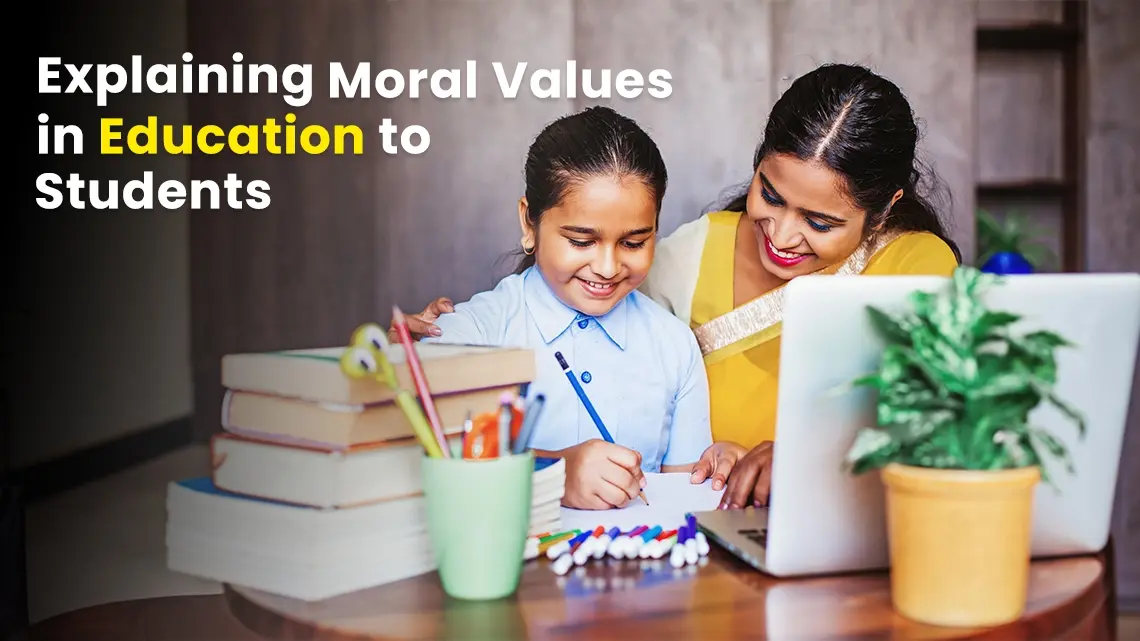
Explaining Moral Values in Education for Students

Introduction: The Essence of True
Education

It’s 2025, and when we talk about education, we don’t only discuss academics or test
marks; parents nowadays want their children to learn more than just textual knowledge;
they want their children to learn “how to be a good human being”.

Parents want their children to learn moral values in school that will help them grow, and
values like honesty, respect, empathy, and discipline are the foundation of a student’s
character.

In this blog, we will talk about why children need to learn values and how schools
emphasize moral education as part of their teaching philosophy.

What Are Moral Values in
Education?

Moral values in education are the principles and beliefs that guide students in
determining what is right and wrong, good and harmful. They shape a student’s behavior,
influencing how they make decisions and interact with others in both their personal and
social lives.

Students learn many common moral values taught in schools, like honesty, kindness,
gratitude, respect, responsibility, and cooperation. These values help students succeed
in their academics and careers in the long run.

Here are some key moral values that schools emphasize:

Why Moral Values are Important for
Students

Moral values like honesty, kindness, gratitude, respect, responsibility, and cooperation
help students develop into good citizens of our society. Here are some reasons to say
why moral values are important for students:

    1. Character Building:

  1. Qualities like confidence,
    honesty, helpfulness, and respect shape a student’s overall personality and
    character.

    2. Develops Emotional Intelligence:

  1. Learning values such as empathy and patience helps students understand and
    manage their emotions effectively.

    3. Encourages Respect and Cooperation:

  1. Students learn to
    respect their teachers, parents, and peers, fostering teamwork and healthy
    relationships.

    4. Promotes Self-Discipline and Responsibility:

  1. Moral
    education teaches students to take responsibility for their actions and stay
    disciplined in their studies and behavior.

    5. Creates Better Citizens:

  1. Moral values help students to
    act with compassion and contribute positively to society, making them responsible
    citizens.

    6. Prepares Students for Real-Life Challenges:

  1. Students
    become emotionally balanced and confident to face life’s ups and downs with
    positivity.

How Teachers and Schools Can
Instill Moral Values

Students spend one-third of their day in school, where they learn from their teachers, so
teachers need to know how they can help their students develop moral values.

    1. Lead by Example:

  1. Teachers and staff of a school should
    be kind and honest in their everyday actions, setting an example for the students to
    follow.

    2. Encourage Group Activities and Teamwork:

  1. Schools can
    encourage students to do group activities like group projects, sports, and classroom
    discussions, helping them practice cooperation, empathy, and leadership.

    3. Include Moral Education in Daily Lessons:

  1. Students
    love to listen to real-life stories and discussions with their teachers, so it is
    important to integrate ethics into regular subjects to make value learning part of
    daily education.

    4. Recognize and Reward Good Behaviour:

  1. Rewarding
    students for their good behavior, like honesty, discipline, and helpfulness,
    encourages other students to follow the same path.

    5. Celebrate Cultural and Value-Based Events:

  1. Schools can
    organize events like Value Weeks, community service drives, and workshops that teach
    unity, respect, and responsibility.

    6. Provide Counselling and Mentorship:

  1. Teachers are the
    real role models of students, so they act as mentors, guiding students through moral
    dilemmas and helping them build emotional strength.

    7. Engage Parents and the Community:

  1. Schools should start
    moral education programs which include parents to ensure that students learn
    consistent values at home and school.

Role of Parents in Moral
Development

Home is the first place where children learn, and parents are their first role models,
which is why parents play a crucial role in shaping a child’s moral foundation. Children
are good observers, which means parents must act as role models by practicing honesty,
kindness, and respect in their everyday lives.

Experiences of sharing, helping others, or handling disagreements peacefully help teach
moral values in everyday situations. Encouraging open conversations about right and
wrong allows children to express their thoughts and develop moral judgment. Set clear
rules, but at the same time, reward them for good behavior, making children feel
motivated to repeat it.

When parents collaborate with teachers and schools, it ensures that children receive
consistent moral guidance both at home and in the classroom, helping them grow into
responsible and compassionate individuals.

Conclusion: Building the Future
with Moral Strength

In today’s fast-paced and competitive world, true education goes far beyond textbooks and
exams; it lies in shaping students into good human beings with strong moral values.
Moral education helps children develop essential life qualities such as honesty,
empathy, respect, and responsibility, guiding them through every stage of life.

Both parents and schools play an equally important role in nurturing these values. While
schools like Vivekanand Assandh focus on integrating moral lessons into daily learning
through activities, mentorship, and value-based programs, parents reinforce the same
values at home through everyday actions and positive guidance.

By working together, schools and families can help children grow into confident, kind,
and responsible individuals, the kind of learners who not only achieve academic
excellence but also carry the wisdom and compassion needed to make the world a better
place.

Enroll your child in an environment that focuses on both education and ethics. Contact
Vivekanand Vidya Niketan today to know more about our value-based learning approach!

FAQs

1. What are the moral values in education?

Ans- Moral values like empathy, kindness, respect, honesty, compassion, perseverance,
hard work, kindness, and gratitude help students to grow into good citizens.

2. What are 10 moral values for students?

Ans- Ten moral values for students are honesty, respect, responsibility, empathy, compassion, integrity,
perseverance, gratitude, self-discipline, and teamwork.

3. How do you teach children morals and values?

Ans- You can teach your children morals and values in the following ways:

  1. 1. Lead by Example
  2. 2. Encourage Group Activities and Teamwork
  3. 3. Include Moral Education in Daily Lessons
  4. 4. Recognize and Reward Good Behaviour
  5. 5. Celebrate Cultural and Value-Based Events
  6. 6. Provide Counselling and Mentorship
  7. 7. Engage Parents and the Community

Vivekanand Vidya Niketan, Assandh Editorial Team

Educational Insights & Student Development

Related Articles

IX – X
Analytical
Thinking
Practical
Learning
Leadership
Skills

Secondary School

The Senior Secondary programme prepares students for academic excellence, competitive success, and future careers. With experienced faculty, structured mentoring, career counselling, and personalised academic support, students develop the confidence and knowledge required to excel in board examinations, competitive entrance tests, and higher education while growing into responsible leaders.

Key Focus Areas

  • Board Examination Excellence
  • Career Guidance
  • Competitive Preparation
  • Research & Innovation
  • Leadership & Personality

Subjects Offered

  • English Language & Literature (184)
  • Hindi Course A (002)
  • Mathematics (041)
  • Science (086)
  • Social Science ( 087)
Experiential Learning
Global Awareness
Curiosity

Educational Excursions

Learning Beyond Classroom Walls
Educational visits provide practical exposure, broaden perspectives, and connect classroom concepts with real-world experiences through engaging field trips and explorations.

What Students Develop

  • Observation Skills
  • Practical Understanding
  • Curiosity
  • Collaboration
  • Cultural Awareness
  • Confidence

Activities Offered

  • Educational Tours
  • Heritage Visits
  • Museum Visits
  • Industrial Visits
  • Nature Camps
  • Science Centres
  • Agricultural Visits
  • Historical Excursions
Leadership
Responsibility
Community Service

Leadership Activities

Preparing Leaders for Tomorrow
Leadership opportunities help students become confident, responsible, and collaborative individuals who are ready to make meaningful contributions inside and outside the classroom.

What Students Develop

  • Leadership
  • Responsibility
  • Teamwork
  • Decision Making
  • Confidence
  • Discipline

Activities Offered

  • Student Council
  • House System
  • NCC
  • Assembly Leadership
  • Event Management
  • Community Service

  • Leadership Workshops
  • Team Projects
Scientific Inquiry
Innovation
Problem Solving

Science & Innovation

Curiosity That Creates Innovation
Hands-on experiments, STEM learning, robotics, and scientific exploration inspire students to think critically, solve problems, and innovate with confidence.

What Students Develop

  • Scientific Thinking
  • Problem Solving
  • Innovation
  • Research Skills
  • Creativity
  • Collaboration

Activities Offered

  • cience Laboratories
  • STEM Activities
  • Robotics
  • Science Exhibitions
  • Innovation Projects
  • Working Models
  • Coding Basics
  • Experiment-Based Learning
Creative Expression
Artistic Skills
Innovation

Art & Creativity

Where Creativity Comes Alive
Students explore imagination through art, music, dance, theatre, and creative activities that encourage self-expression, innovation, and confidence beyond academics.

What Students Develop

  • Creativity
  • Self Expression
  • Imagination
  • Confidence
  • Fine Motor Skills
  • Artistic Appreciation

Activities Offered

  • Drawing & Painting
  • Craft Activities
  • Music
  • Dance
  • Theatre
  • Poster Making
  • Rangoli
  • Cultural Performances
  • Art Exhibitions
Communication
Critical Thinking
Leadership

Debate & Public Speaking

Confident Voices That Inspire
At Vivekanand Vidya Niketan, Assandh, students build confidence through debates, speeches, declamations, and public speaking activities that strengthen communication, critical thinking, and leadership.

What Students Develop

  • Public Speaking
  • Communication Skills
  • Critical Thinking
  • Confidence
  • Leadership
  • Logical Reasoning

Activities Offered

  • Debate Competitions
  • Declamation
  • Extempore
  • Public Speaking
  • Anchoring
  • Presentations
  • Group Discussions
  • Elocution
Physical
Fitness
Teamwork
Leadership

Sports & Athletics

Building Strength Through Discipline and Teamwork
At Vivekanand Vidya Niketan, Assandh, sports inspire students to develop fitness, confidence, resilience, and leadership through regular training, competitive participation, and teamwork. Every game encourages discipline, determination, and a healthy sporting spirit.

What Students Develop

  • Physical Fitness
  • Discipline
  • Teamwork
  • Leadership
  • Confidence
  • Sportsmanship

Sports Offered

  • Football
  • Handball
  • Volleyball
  • Netball
  • Basketball
  • Athletics
  • Judo Karate
  • Boxing
  • Cricket
  • Wushu
  • Kabaddi
  • Kho Kho
  • Skating
  • Badminton
  • Chess
IX – XII
Expert
Mentorship
Performance
Analytics
Competitive
Success

Competitive Excellence Programme

The Competitive Excellence Programme at Vivekanand Vidya Niketan, Assandh is designed to help ambitious learners achieve their highest academic aspirations. With integrated classroom learning, expert mentorship, regular assessments, mock examinations, doubt-solving sessions, and personalised guidance, students receive structured preparation for IIT-JEE, NEET, Olympiads, Foundation courses, and other competitive examinations while maintaining excellence in school academics.

Key Focus Areas

  • IIT-JEE Preparation
  • NEET Preparation
  • Foundation Programme
  • Olympiad Training
  • Mock Tests & Assessments
  • Personalised Mentorship

Programme Includes

  • Integrated School + Competitive Curriculum
  • Expert Faculty
  • Regular Mock Tests
  • Doubt-Solving Sessions
  • Performance Tracking
  • Study Material
  • Career Guidance
IX – XII
Academic
Excellence
Career
Readiness
Future
Leaders

Senior Secondary

The Senior Secondary programme prepares students for academic excellence, competitive success, and future careers. With experienced faculty, structured mentoring, career counselling, and personalised academic support, students develop the confidence and knowledge required to excel in board examinations, competitive entrance tests, and higher education while growing into responsible leaders.

Key Focus Areas

  • Board Examination Excellence
  • Career Guidance
  • Competitive Preparation
  • Research & Innovation
  • Leadership & Personality

Subjects Offered

  • English Core(301)
  • Physics (042)
  • Chemistry (043)
  • Biology (044)
  • Physical Education(048)

Subjects Offered

  • English Core(301)
  • Physics (042)
  • Chemistry (043)
  • Mathematics (041)
  • Physical Education (048)

Subjects Offered

  • English Core(301)
  • Accountancy (055)
  • Business Studies (054)
  • Economics(030)
    (OR)
    Mathematics (041)
  • Physical Education (048)

Subjects Offered

  • English Core(301)
  • Hindi Core (302)
  • History (027)
  • Economics(030)/Political Science(028)
    (OR)
    Mathematics (041)
  • Physical Education (048)
VI – VIII
Analytical
Thinking
Practical
Learning
Leadership
Skills

Middle School

The Middle School years empower students to become confident learners, independent thinkers, and responsible individuals. Through concept-driven academics, practical applications, collaborative learning, and leadership opportunities, students strengthen analytical abilities while preparing for higher academic challenges. A balanced curriculum encourages curiosity, innovation, teamwork, and personal growth.

Key Focus Areas

  • Critical Thinking
  • Concept-Based Learning
  • Scientific Temper
  • Leadership Development
  • Collaboration & Teamwork
  • Skill-Based Learning
  • Digital Literacy

Subjects Offered

  • English
  • Mathematics
  • EVS / Science
  • Social Studies
  • Computer Science
  • Art & Craft
  • Physical Education
Nursery – II
Early Learning
Creative Play
Social Skills

Foundational Years

The Foundational Years at Vivekanand Vidya Niketan, Assandh create a joyful beginning to every child’s learning journey. Through play-based experiences, interactive classrooms, and nurturing guidance, children develop confidence, curiosity, communication skills, and strong early literacy and numeracy foundations. Every day is designed to inspire exploration, creativity, and a lifelong love for learning in a safe and caring environment.

Key Focus Areas

  • Early Literacy & Numeracy
  • Language Development
  • Social & Emotional Growth
  • Play-Based Learning
  • Creativity & Imagination
  • Motor Skill Development
  • Values & Good Habits

Subjects Offered

  • English
  • Hindi
  • Mathematics
  • Environmental Awareness
  • Art & Craft
  • Music & Dance
  • Physical Education
  • Storytelling & Communication
  • Activity-Based Learning
Classes I – V
Conceptual
Learning
Creativity
Life Skills

Primary Wing

The Primary Wing strengthens conceptual learning while encouraging creativity, communication and experiential learning. Students are guided through practical activities and collaborative experiences that build strong academic foundations.

Key Focus Areas

  • Conceptual Understanding
  • Communication Skills
  • Creativity & Innovation
  • Experiential Activities
  • Discipline & Responsibility
  • Collaboration & Teamwork

Subjects Offered

  • English
  • Mathematics
  • EVS / Science
  • Social Studies
  • Computer Science
  • Art & Craft
  • Physical Education