Education in the Vedic Period: Is it still Effective

Introduction:

We have learned many things from our past, and we continue to learn from past mistakes and the discoveries of great ancestors as we read our history books. Many schools still adhere to old traditions and practices, while others have adopted new technology instead.

The Vedic period is one of the earliest educational systems, which was formed to give exposure to real life, discipline, and hard work to children. The discoveries, inventions, theories, and concepts of modern times are largely based on Vedic knowledge.

But the main question is, can we still learn from it? In this blog, we will learn about what we can still learn from the education system of the Vedic period.

Overview of Education in the Vedic Period

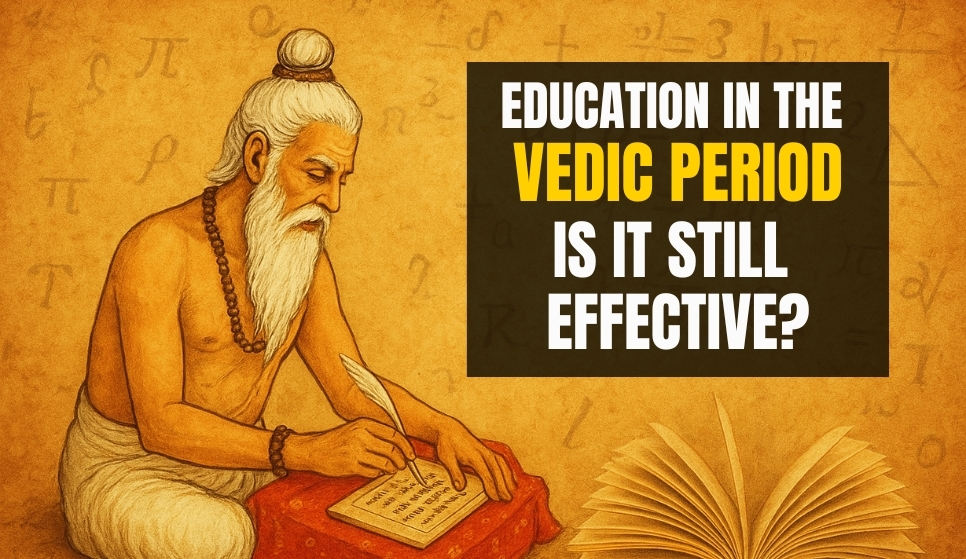
The Vedic period was between 1500 BCE and 500 BCE; this was the era in which the Vedas, Upanishads, and early scriptures were composed. Education in this era was not just about theoretical knowledge or physical skills; it was more about spirituality and philosophy, and moral values.

Purpose of Education

In the Vedic period, the purpose of education was not just knowledge but also character development and self-realization. The education system in the Vedic period focused on shaping a disciplined, ethical, and spiritual individual.

System of Learning

The Gurukul system was the foundation of the Vedic educational system, where students used to live with teachers and follow a disciplined life. At that time, learning was more likely considered sacred, so students had to learn while serving their teachers and community to build a great impression.

Mode of Teaching

The mode of teaching was mostly oral, known as Shruti and Smriti. Shruti was the information passed by the teacher to the student, while Smriti meant the words that the student remembered after listening to the teacher.

Core Features of Vedic Education

1. Gurukul System

  • Teacher-student bond: Unlike nowadays, where there is little to no true bond between teachers and students, in the Vedic times, teachers and students used to live together to help the students get knowledge, which made a bond between them.
  • Life skills: In the past, education was more about life skills and survival rather than gaining theoretical knowledge, making the students strong physically and mentally.

2. Subjects of Study

  • Vedic literature includes the following: 4 Vedas, 6 Vedangas, 4 Upvedas, 4 Brahmanas, 184 Upanishads, 6 systems of philosophy, the Bhagavad Gita, and 3 Smritis.
  • Other than these, students also learned grammar, mathematics, astronomy, medicine, ethics, and moral values.

3. Teaching Methods

  • Oral recitation: In the Vedic period, most of the learning was done through oral communication, known as Shruti and Smriti.
  • Hands-on learning: As the learning is done through daily tasks, students learn practical skills with knowledge.

Advantages of the Vedic Education System

  • The Vedic education system focuses more on the overall or holistic development, which includes the mind, body, and soul.
  • The quality of education is deeper and more diverse than today because it includes day-to-day tasks that help the students to be physically and mentally more active.
  • Rather than focusing more on theoretical knowledge, it used to focus more on disciplining the students and teaching them how to show respect.
  • Other than knowledge, students also learned how to meditate and be more connected with nature and real life.

Limitations of Vedic Education

  • In the Vedic times, many women were not allowed to join the gurukuls, as they thought that it was not a woman’s role to study. Also, mostly nobles had the privilege to join a gurukul, which made it restricted to only the nobles.
  • Rather than writing anything or storing the knowledge, they used to memorize everything, which created a loss of much useful information.
  • If we were to compare the old education system with modern standards, then there wouldn’t be an alignment because current education is more about job seeking and money making rather than personal development.

Lessons from Vedic Education for Today

1. Value-Based Education

Vedic education stressed ethics, morality, and discipline alongside academics, which should also be implemented in current education, as it helps children to grow well in a holistic way.

2. Strong Teacher-Student Bond

In the Gurukul system, teachers acted as mentors for life, not just instructors; they used to help students in their personal development and their knowledge development.

3. Learning Beyond Books and Exams

Students in Vedic times learned practical life skills like discipline, teamwork, and service to society. Similarly, today’s education must go beyond rote memorization and exams, encouraging project-based learning, problem-solving, and real-world applications.

4. Balance of Knowledge and Character

The Vedic education system empowered both knowledge and character, while the current system only focuses on building knowledge.

Discover the priority of modern education: Modern Education: Exams to Empathy. What Should We Prioritize?

Can the Vedic System Still Be Implemented Today?

The Vedic education system was created for a simple, nature-centered society, very different from today’s fast-paced, technology-driven world. Yet, many of its principles remain relevant.

What We Can Adopt:

  • Value-based learning will help us instill ethics, discipline, and empathy in our students.
  • Teacher-student mentorship for personal growth beyond academics.
  • Connection with nature through outdoor education and eco-projects.
  • Holistic development with a balance of academics, yoga, arts, and life skills.

What Needs Change:

  • Ensuring equal access for all, unlike the exclusivity of ancient times.
  • Integrating modern sciences and technology with traditional wisdom.
  • Moving from rote memorization to critical thinking and creativity.

In short, the Vedic system cannot be fully replicated today. Still, a hybrid model, blending ancient values with modern education, can create students who are not only skilled but also wise and compassionate.

Conclusion

The Vedic education system may belong to the past, but its lessons are timeless. While we cannot bring it back in its original form, we can surely take inspiration from its values, discipline, respect for teachers, balance between knowledge and character, and connection with nature.

By blending these principles with modern subjects, technology, and inclusivity, education can once again become a tool for shaping not just successful professionals but responsible and compassionate human beings. After all, true education is not just about earning a living but about learning how to live.

The education system has to change with time as the values and wants of people change, but there are some schools that still use a hybrid school system that helps your children to grow in a holistic way. One of these schools is Vivekanand Vidya Niketan , which helps your child grow exponentially.

FAQs

1. What were the methods of Vedic education?

Ans- The methods of Vedic education emphasize the teacher-student bond, life skills, and spiritual connection.

2. What was the education system in the ancient period?

Ans- The Gurukul system was used as an educational system in the ancient period.
Vivekanand Vidya Niketan, Assandh Editorial Team

Educational Insights & Student Development

Related Articles

IX – X
Analytical
Thinking
Practical
Learning
Leadership
Skills

Secondary School

The Senior Secondary programme prepares students for academic excellence, competitive success, and future careers. With experienced faculty, structured mentoring, career counselling, and personalised academic support, students develop the confidence and knowledge required to excel in board examinations, competitive entrance tests, and higher education while growing into responsible leaders.

Key Focus Areas

  • Board Examination Excellence
  • Career Guidance
  • Competitive Preparation
  • Research & Innovation
  • Leadership & Personality

Subjects Offered

  • English Language & Literature (184)
  • Hindi Course A (002)
  • Mathematics (041)
  • Science (086)
  • Social Science ( 087)
Experiential Learning
Global Awareness
Curiosity

Educational Excursions

Learning Beyond Classroom Walls
Educational visits provide practical exposure, broaden perspectives, and connect classroom concepts with real-world experiences through engaging field trips and explorations.

What Students Develop

  • Observation Skills
  • Practical Understanding
  • Curiosity
  • Collaboration
  • Cultural Awareness
  • Confidence

Activities Offered

  • Educational Tours
  • Heritage Visits
  • Museum Visits
  • Industrial Visits
  • Nature Camps
  • Science Centres
  • Agricultural Visits
  • Historical Excursions
Leadership
Responsibility
Community Service

Leadership Activities

Preparing Leaders for Tomorrow
Leadership opportunities help students become confident, responsible, and collaborative individuals who are ready to make meaningful contributions inside and outside the classroom.

What Students Develop

  • Leadership
  • Responsibility
  • Teamwork
  • Decision Making
  • Confidence
  • Discipline

Activities Offered

  • Student Council
  • House System
  • NCC
  • Assembly Leadership
  • Event Management
  • Community Service
  • Leadership Workshops
  • Team Projects
Scientific Inquiry
Innovation
Problem Solving

Science & Innovation

Curiosity That Creates Innovation
Hands-on experiments, STEM learning, robotics, and scientific exploration inspire students to think critically, solve problems, and innovate with confidence.

What Students Develop

  • Scientific Thinking
  • Problem Solving
  • Innovation
  • Research Skills
  • Creativity
  • Collaboration

Activities Offered

  • cience Laboratories
  • STEM Activities
  • Robotics
  • Science Exhibitions
  • Innovation Projects
  • Working Models
  • Coding Basics
  • Experiment-Based Learning
Creative Expression
Artistic Skills
Innovation

Art & Creativity

Where Creativity Comes Alive
Students explore imagination through art, music, dance, theatre, and creative activities that encourage self-expression, innovation, and confidence beyond academics.

What Students Develop

  • Creativity
  • Self Expression
  • Imagination
  • Confidence
  • Fine Motor Skills
  • Artistic Appreciation

Activities Offered

  • Drawing & Painting
  • Craft Activities
  • Music
  • Dance
  • Theatre
  • Poster Making
  • Rangoli
  • Cultural Performances
  • Art Exhibitions
Communication
Critical Thinking
Leadership

Debate & Public Speaking

Confident Voices That Inspire
At Vivekanand Vidya Niketan, Assandh, students build confidence through debates, speeches, declamations, and public speaking activities that strengthen communication, critical thinking, and leadership.

What Students Develop

  • Public Speaking
  • Communication Skills
  • Critical Thinking
  • Confidence
  • Leadership
  • Logical Reasoning

Activities Offered

  • Debate Competitions
  • Declamation
  • Extempore
  • Public Speaking
  • Anchoring
  • Presentations
  • Group Discussions
  • Elocution
Physical
Fitness
Teamwork
Leadership

Sports & Athletics

Building Strength Through Discipline and Teamwork
At Vivekanand Vidya Niketan, Assandh, sports inspire students to develop fitness, confidence, resilience, and leadership through regular training, competitive participation, and teamwork. Every game encourages discipline, determination, and a healthy sporting spirit.

What Students Develop

  • Physical Fitness
  • Discipline
  • Teamwork
  • Leadership
  • Confidence
  • Sportsmanship

Sports Offered

  • Football
  • Handball
  • Volleyball
  • Netball
  • Basketball
  • Athletics
  • Judo Karate
  • Boxing
  • Cricket
  • Wushu
  • Kabaddi
  • Kho Kho
  • Skating
  • Badminton
  • Chess
IX – XII
Expert
Mentorship
Performance
Analytics
Competitive
Success

Competitive Excellence Programme

The Competitive Excellence Programme at Vivekanand Vidya Niketan, Assandh is designed to help ambitious learners achieve their highest academic aspirations. With integrated classroom learning, expert mentorship, regular assessments, mock examinations, doubt-solving sessions, and personalised guidance, students receive structured preparation for IIT-JEE, NEET, Olympiads, Foundation courses, and other competitive examinations while maintaining excellence in school academics.

Key Focus Areas

  • IIT-JEE Preparation
  • NEET Preparation
  • Foundation Programme
  • Olympiad Training
  • Mock Tests & Assessments
  • Personalised Mentorship

Programme Includes

  • Integrated School + Competitive Curriculum
  • Expert Faculty
  • Regular Mock Tests
  • Doubt-Solving Sessions
  • Performance Tracking
  • Study Material
  • Career Guidance
IX – XII
Academic
Excellence
Career
Readiness
Future
Leaders

Senior Secondary

The Senior Secondary programme prepares students for academic excellence, competitive success, and future careers. With experienced faculty, structured mentoring, career counselling, and personalised academic support, students develop the confidence and knowledge required to excel in board examinations, competitive entrance tests, and higher education while growing into responsible leaders.

Key Focus Areas

  • Board Examination Excellence
  • Career Guidance
  • Competitive Preparation
  • Research & Innovation
  • Leadership & Personality

Subjects Offered

  • English Core(301)
  • Physics (042)
  • Chemistry (043)
  • Biology (044)
  • Physical Education(048)

Subjects Offered

  • English Core(301)
  • Physics (042)
  • Chemistry (043)
  • Mathematics (041)
  • Physical Education (048)

Subjects Offered

  • English Core(301)
  • Accountancy (055)
  • Business Studies (054)
  • Economics(030)
    (OR)
    Mathematics (041)
  • Physical Education (048)

Subjects Offered

  • English Core(301)
  • Hindi Core (302)
  • History (027)
  • Economics(030)/Political Science(028)
    (OR)
    Mathematics (041)
  • Physical Education (048)
VI – VIII
Analytical
Thinking
Practical
Learning
Leadership
Skills

Middle School

The Middle School years empower students to become confident learners, independent thinkers, and responsible individuals. Through concept-driven academics, practical applications, collaborative learning, and leadership opportunities, students strengthen analytical abilities while preparing for higher academic challenges. A balanced curriculum encourages curiosity, innovation, teamwork, and personal growth.

Key Focus Areas

  • Critical Thinking
  • Concept-Based Learning
  • Scientific Temper
  • Leadership Development
  • Collaboration & Teamwork
  • Skill-Based Learning
  • Digital Literacy

Subjects Offered

  • English
  • Mathematics
  • EVS / Science
  • Social Studies
  • Computer Science
  • Art & Craft
  • Physical Education
Nursery – II
Early Learning
Creative Play
Social Skills

Foundational Years

The Foundational Years at Vivekanand Vidya Niketan, Assandh create a joyful beginning to every child’s learning journey. Through play-based experiences, interactive classrooms, and nurturing guidance, children develop confidence, curiosity, communication skills, and strong early literacy and numeracy foundations. Every day is designed to inspire exploration, creativity, and a lifelong love for learning in a safe and caring environment.

Key Focus Areas

  • Early Literacy & Numeracy
  • Language Development
  • Social & Emotional Growth
  • Play-Based Learning
  • Creativity & Imagination
  • Motor Skill Development
  • Values & Good Habits

Subjects Offered

  • English
  • Hindi
  • Mathematics
  • Environmental Awareness
  • Art & Craft
  • Music & Dance
  • Physical Education
  • Storytelling & Communication
  • Activity-Based Learning
Classes I – V
Conceptual
Learning
Creativity
Life Skills

Primary Wing

The Primary Wing strengthens conceptual learning while encouraging creativity, communication and experiential learning. Students are guided through practical activities and collaborative experiences that build strong academic foundations.

Key Focus Areas

  • Conceptual Understanding
  • Communication Skills
  • Creativity & Innovation
  • Experiential Activities
  • Discipline & Responsibility
  • Collaboration & Teamwork

Subjects Offered

  • English
  • Mathematics
  • EVS / Science
  • Social Studies
  • Computer Science
  • Art & Craft
  • Physical Education