
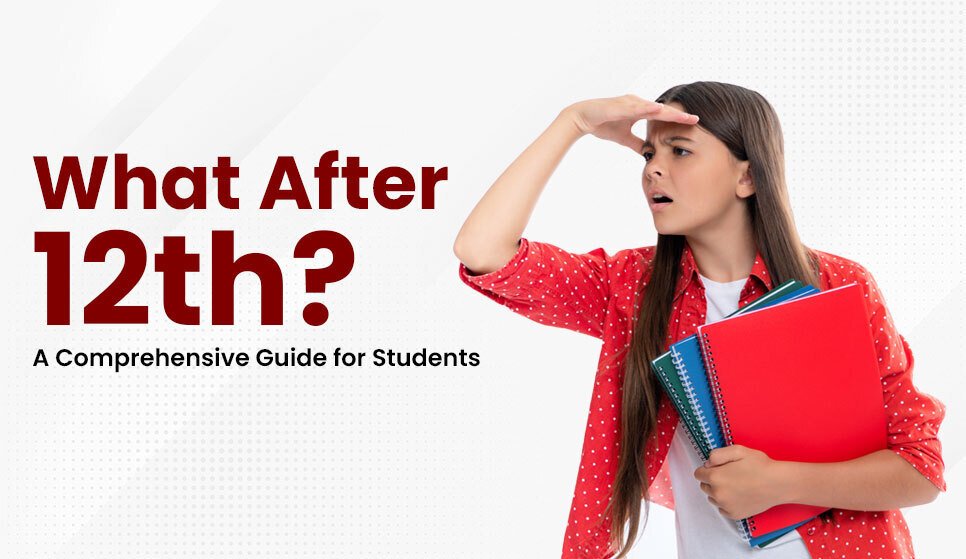
Explore the top career options and study choices after completing 10+2 in different
streams & the role of VVN in providing hands-on experience to students
What After 12th? A Comprehensive
Guide for Students in India
As soon as a child is born in an Indian household, what he will become after growing up
becomes the most crucial question.
Every time, at every point in life, he/she was asked, “Bade hoke kya banoge?” The child
always says some conventional profession, but as time passes and the child experiences
life, he/she explores all the other opportunities.
The ending of school life with passing 12th grade marks a significant change in a
person’s life as he/she moves into a new phase of life, the most important one.
To minimise the confusion of which career to choose, here is a comprehensive guide to
help students and parents explore the options available after the 12th, keeping the
Indian education system and job market in mind.
CBSE is a nationally recognized educational board, to guarantee that the curriculum &
examination standards are consistent across the nation. This uniformity can be
especially beneficial for families needing to relocate due to work or other reasons.
Why Choosing the
Right Path Matters
The market is full of options that sometimes confuse the student. The student should
understand the emerging professions and skills related to them.
Industries like artificial intelligence, machine learning, data science, biotechnology,
and renewable energy are growing rapidly, creating demand for skilled professionals.
Whether it’s higher studies, skill-based courses, or entering the workforce, the chosen
path should align with the student’s goals and interests. Staying informed about such
trends can help students make future-ready decisions.
Getting into the right job is not just about professional fulfilment; sometimes it’s more
about personal fulfilment, too.
Parents, teachers, and facilitators play a critical role in providing guidance and career
support to the student during this crucial time. A well-thought-out decision can lead to
a satisfying career and a balanced life.
Higher Education
Streams After 12th
1. Science Stream
The science stream provides a multitude of career opportunities in technical, medical,
and research fields. Here are some well-approved options:
Engineering (B.Tech/B.E.): Engineering remains a top choice for science students;
it is the most preferred career option parents choose if their child has opted for the
science stream. Institutes like IITs, NITs, and private universities like BITS Pilani
are popular choices. According to AICTE data, around 15 lakh engineers graduate every
year.
Medical (MBBS, BDS): If you dream of becoming a doctor, courses like MBBS and BDS
are perfect. Specialisations like cardiology, paediatrics, and neurology provide
opportunities to impact healthcare significantly. NEET is the common entrance exam for
medical courses in India.
Pure Sciences (B.Sc.): This 3-year bachelor’s degree in any subject like Physics,
Chemistry, Biology, or Mathematics can lead to opportunities in research and teaching.
Pharmacy (B.Pharm):Inorganic chemistry, anatomy, pharmaceutical analysis,
pathophysiology, pharmaceutics, and pharmacology are just a few of the many fundamental
modules and disciplines that make up the four-year undergraduate Bachelor of Pharmacy
(B.Pharm) curriculum, which provides complete knowledge in pharmacy.
2. Commerce Stream
CA/CS- Chartered accountant and company secretary courses are some of the most
sought-after courses for accounting, taxation, and law students. Both these courses have
their entrance exams and provide excellent career opportunities to the students with
good earning potential.
B.Com- The three-year undergraduate Bachelor of Commerce program aims to develop
students’ business abilities and knowledge.
Management (BBA/MBA): Students who aspire to be entrepreneurs or business
strategists tend to join the BBA and MBA Programs to sharpen their skills to flourish in
their industry. Top institutes like the Indian Institute of Management (IIM) and Xavier
School of Management (XLRI) offer world-class MBA programs.
3. Arts stream
Bachelor of Arts (B.A.): For students who want to specialise in some subjects, a
Bachelor of Arts is a perfect choice as the students can specialise in any subject in
this 3-year undergraduate course.
Journalism and Mass Communication:Journalism and Mass Communication: To the
students whom the media industry excites, especially print, digital, and broadcast
media, choosing Journalism and Mass Communication is one of the best options the student
can opt for.
Law (LLB):Students can be admitted into BA/ BCom (LLB) after passing +2. It’s a
5-year integrated course.
Bachelor of Fine Arts (BFA): This program is open to imaginative students who like
to paint and draw. It may serve as a springboard for jobs designing the interiors of
residences, vehicles, hotels, structures, etc.
4. Some of the emerging profession
Emerging Technologies (AI and ML)—Artificial intelligence and machine learning are
the most rapidly evolving sectors with huge potential. Most engineering colleges have
incorporated dedicated degrees for these fields that students can opt for after JEE.
Students who dream of making a career in robotics and new-age technologies can opt for
them.
Entrepreneurship/Startups: If you dream of becoming an entrepreneur, the most
suitable way is to join a startup where you can gain hands-on experience in operations
and planning. With ample experience, students can start their entrepreneurial journey.
What are the ways
to choose the correct career path?
Choosing the correct path is most important, where guidance plays a crucial role. There
are sources from where you can seek advice.
- Have a detailed discussion with your teachers, inform them
about your interests, and have insights about possible prospects in that field. - Talk with people in the family working in the professional
world to seek your guidance. - Attend career workshops to gain detailed insights about the
job market and the pros/cons of every field. - Network building is a very crucial part of choosing the
correct career path. Connect with people on LinkedIn from the same college or
university to gain insights.
What after making
a decision?
Once you have decided on your career path, start reading about available colleges from
where you can pursue higher education. Research colleges and universities that provide
the courses.
Read about their course framework, course affiliation, placement records, campus life,
and alumni network to gain better insights.
Why is an informed
decision important?
Making an informed decision is crucial to check if your career path matches your
long-term aspirations. Your career path will evolve over a while.
What’s important is to have flexibility and adaptability to adjust according to the
ever-evolving job market.
What is the role
of parents in helping their ward choose the correct career path?
Parents play a very crucial role when their ward selects a career path. Parents should
counsel the child patiently and should listen to his/her opinions and interests.
Parents should not impose their will for a particular career path on their child upon
hearing the society.
A career path according to a child’s will will always be more beneficial in the long run,
where he/she can grow and learn.
Role of VVN in
guiding students & choosing the right career path
At Vivekanand Vidya Niketan (VVN), we provide students with a holistic learning
environment that helps them explore their interests and choose the right career path.
Our state-of-the-art facilities and skill-based programs ensure students receive both
academic and extracurricular exposure to identify their strengths.
- The Vivekanand Library and Hi-Tech Smart Class enhance
learning through modern educational resources, fostering research and analytical
skills. - Atal Tinkering Lab (ATL) and Computer & Coding Lab nurture
innovation, problem-solving, and tech-driven careers like AI, robotics, and software
development. - Physics, chemistry, biology, and mathematics labs offer
hands-on experiments, helping students develop a passion for science and engineering
fields. - Music, Dance, and Art & Craft Rooms encourage creativity,
preparing students for careers in performing arts, design, and visual storytelling. - Language Lab enhances communication skills, benefiting
students aiming for careers in media, public speaking, and international relations. - Sports and NCC (Air Wing) instil leadership, teamwork, and
discipline, shaping future athletes, defence personnel, and professionals in sports
management. - Activity Room and Unity & Discipline (Ekta aur Anushasan)
programs emphasize teamwork, strategic thinking, and personal development.
Through these diverse opportunities, VVN ensures that every student gains practical
experience, discovers their passions, and makes informed career choices for a successful
future.
Conclusion
The journey after class 12 provides many pathways. Choosing a path that goes with your
ambitions and interests is essential.
What’s important is to embrace the challenges ahead, keep your mind open for new
learnings, and upgrade your skill set per the market requirements.